The National Geologic Map Database is migrating to a new infrastructure. We apologize for any service disruptions during this process.
|
|---|


- Usage in publication:
-
- Cottonwood Creek bed
- Modifications:
-
- Original reference
- Dominant lithology:
-
- Sandstone
- Clay
- AAPG geologic province:
-
- Bend arch
- Llano uplift
Summary:
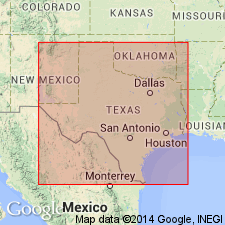
Pg. 374, 382. Cottonwood Creek bed in Strawn division. Chiefly nearly white friable sandstone, 300 feet thick; in places part of bed consists of massive, moderately hard strata. Member of Strawn division [Strawn is 2nd from base of 5 Carboniferous divisions of Cummins, 1891]. Underlies Hanna Valley bed and overlies Spring Creek bed. Age is Pennsylvanian.
[Named from Cottonwood Creek, San Saba Co., Colorado River region, central TX.]
Source: US geologic names lexicon (USGS Bull. 896, p. 530).
- Usage in publication:
-
- Cottonwood Creek bed
- Modifications:
-
- Areal extent
- AAPG geologic province:
-
- Fort Worth syncline
Summary:
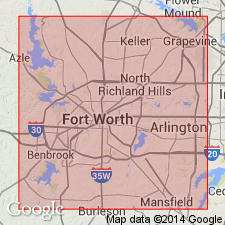
Pg. 72. Cottonwood Creek bed in Strawn series. Chiefly white friable sandstone, 300 feet thick. Underlies Hanna Valley bed; overlies Spring Creek bed. [Age is Pennsylvanian; age of Strawn not discussed.]
[Report area in Parker County, central Texas.]
Source: US geologic names lexicon (USGS Bull. 1200, p. 955); supplemental information from GNU records (USGS DDS-6; Denver GNULEX).
- Usage in publication:
-
- Cottonwood Creek bed
- Modifications:
-
- Not used
- AAPG geologic province:
-
- Bend arch
Summary:
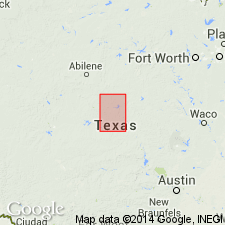
Pg. 58, pl. 27. [†Cottonwood Creek bed of Strawn formation not used by the USGS; a local term considered obsolete. See also entry under Strawn.] Drake (1893) separated rocks of Strawn group [division] into 20 units of alternating sandstone and shale beds. He gave local names to these units, or "beds" as he termed them, and numbered them from bottom to top, 4 to 23. Only Drake's name for upper unit, the Ricker, is in common use today, and that name has been restricted to the base of Drake's Ricker bed.
Source: US geologic names lexicon (USGS Bull. 1200, p. 955).
For more information, please contact Nancy Stamm, Geologic Names Committee Secretary.
Asterisk (*) indicates published by U.S. Geological Survey authors.
"No current usage" (†) implies that a name has been abandoned or has fallen into disuse. Former usage and, if known, replacement name given in parentheses ( ).
Slash (/) indicates name conflicts with nomenclatural guidelines (CSN, 1933; ACSN, 1961, 1970; NACSN, 1983, 2005, 2021). May be explained within brackets ([ ]).