

- Usage in publication:
-
- Green Canyon group
- Modifications:
-
- Named
- Dominant lithology:
-
- Limestone
- Shale
- Chert
- Siltstone
- AAPG geologic province:
-
- Orogrande basin
Summary:
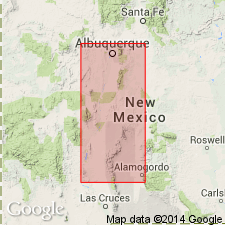
Name proposed for rocks of the two basal formations of Derry series, which is newly named, this report: Arrey formation (new, at base) and Apodoca formation (new, at top). Name derived from Green Canyon, about 1/2 mi north of village of Derry, Sierra Co, NM in Orogrande basin, but type locality is a section measured on west-facing slope of hill approximately 3/4 mi east of Derry and is same as type locality for Derry series. 87 ft thick at type [text of report shows 87, but measured section shows 112 ft thick]. Distribution discussed in description of individual formations. Group composed of (ascending): dense, massive limestones; highly nodular limestones with irregular, interbedded, highly calcareous shales; and very common, irregular masses and lenses of chert, nodular limestones, calcareous shales, black to dark-gray calcareous siltstones, and greenish to bluish-gray shales. To south consists of essentially pure limestone. To north is more highly clastic. Highly fossiliferous. Underlies Hot Springs formation (new) of Mud Springs group (new) of Derry series; unconformably overlies Devonian rocks. Is of Pennsylvanian (Derry) age.
Source: GNU records (USGS DDS-6; Denver GNULEX).
For more information, please contact Nancy Stamm, Geologic Names Committee Secretary.
Asterisk (*) indicates published by U.S. Geological Survey authors.
"No current usage" (†) implies that a name has been abandoned or has fallen into disuse. Former usage and, if known, replacement name given in parentheses ( ).
Slash (/) indicates name conflicts with nomenclatural guidelines (CSN, 1933; ACSN, 1961, 1970; NACSN, 1983, 2005, 2021). May be explained within brackets ([ ]).