

- Usage in publication:
-
- Dry Canyon Sandstone Member*
- Modifications:
-
- Named
- Dominant lithology:
-
- Sandstone
- Siltstone
- AAPG geologic province:
-
- Transverse Ranges province
Summary:
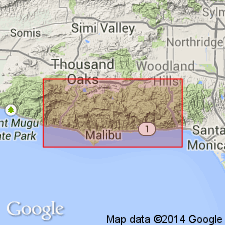
Type area: Dry Canyon, Santa Monica Mountains, west central Malibu Beach quad, Los Angeles Co, CA. Consists of sandstone, siltstone, dolomitic concretions in siltstone. Forms thin turbidites and broken coarse-grained arkosic arenite containing reworked(?) Miocene mollusks. Is 686 m thick. Is oldest member (of 6) of Calabasas Formation. Overlies Ramera Canyon Tongue (new) (Conejo Volcanics); intertongues with Escondido Canyon Shale Member (new) and Latigo Canyon Breccia Member (new) (both of Calabasas Formation) and Solstice Canyon Tongue (new) (Conejo Volcanics); underlies Newell Sandstone Member (new) (Calabasas Formation) and Malibu Bowl Tongue (Conejo Volcanics). Is middle Miocene age.
Source: GNU records (USGS DDS-6; Menlo GNULEX).
For more information, please contact Nancy Stamm, Geologic Names Committee Secretary.
Asterisk (*) indicates published by U.S. Geological Survey authors.
"No current usage" (†) implies that a name has been abandoned or has fallen into disuse. Former usage and, if known, replacement name given in parentheses ( ).
Slash (/) indicates name conflicts with nomenclatural guidelines (CSN, 1933; ACSN, 1961, 1970; NACSN, 1983, 2005, 2021). May be explained within brackets ([ ]).