The National Geologic Map Database is migrating to a new infrastructure. We apologize for any service disruptions during this process.
|
|---|


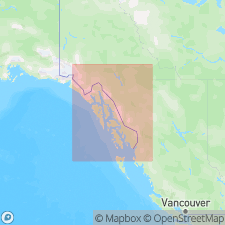
- Usage in publication:
-
- Coast Mountains Complex*
- Modifications:
-
- Named
- AAPG geologic province:
-
- Alaska Southeastern region
Summary:
Unit is named for the Coast Mountains physiographic province. Consists of a mixture of intrusive rocks (about 70%), metamorphic rocks and some small outliers of young volcanic rocks; also includes at least one area of very low-grade metamorphic rocks (within the central granitic zone). Protoliths of the metamorphic rocks range from Late Proterozoic to Cretaceous in age, and they were metamorphosed during several episodes--the most important being the Early and Middle Triassic, Early Cretaceous, and latest Cretaceous. The Coast Mountains Complex, as a whole, extends from the latitude of the North Cascades of WA and BC into AK west of the 141st meridian, a distance of about 1750 km. In southeastern AK and adjacent parts of BC, the complex is divided into four major, northwest-striking belts or zones: western metamorphic belt, central metamorphic zone, central granitic zone, and eastern metamorphic zone. The western boundary of the Coast Mountains Complex is either the eastern contact of the Gravina overlap assemblage rocks, or, where those rocks have been metamorphosed, the western limit of the metamorphic effects. The eastern boundary of the unit is either the eastern limit of the metamorphism associated with the Tertiary plutons, or, where Nisling terrane pre-Tertiary metamorphic rocks adjoin the Tertiary intrusions, the eastern contact of those metamorphic rocks. Age is regarded as Cretaceous and Tertiary (since most of the unit's intrusive and metamorphic-forming events occurred during that time interval).
Source: GNU records (USGS DDS-6; Menlo GNULEX).
For more information, please contact Nancy Stamm, Geologic Names Committee Secretary.
Asterisk (*) indicates published by U.S. Geological Survey authors.
"No current usage" (†) implies that a name has been abandoned or has fallen into disuse. Former usage and, if known, replacement name given in parentheses ( ).
Slash (/) indicates name conflicts with nomenclatural guidelines (CSN, 1933; ACSN, 1961, 1970; NACSN, 1983, 2005, 2021). May be explained within brackets ([ ]).