The National Geologic Map Database is migrating to a new infrastructure. We apologize for any service disruptions during this process.
|
|---|


- Usage in publication:
-
- Devils Gate limestone
- Modifications:
-
- Named
- AAPG geologic province:
-
- Great Basin province
Summary:
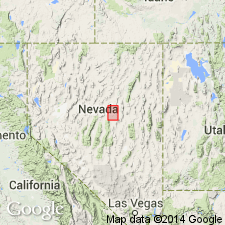
Unit is named the Devils Gate limestone. Name applies to upper 2065 ft of Devonian strata exposed at Devils Gate and Modoc Ridge, east of Yahoo Canyon. Overlies the Nevada formation (restricted and redefined); underlies unit referred to as the Diamond Peak series (includes the Diamond Peak quartzite and White Pine shale). Age is Middle and Late Devonian.
Source: GNU records (USGS DDS-6; Menlo GNULEX).
- Usage in publication:
-
- Devils Gate limestone*
- Modifications:
-
- Adopted
- Biostratigraphic dating
Summary:
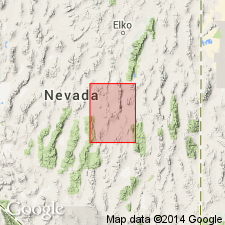
Devils Gate limestone of Merriam (1940) is adopted. Described in vicinity of Eureka where it consists largely of thick-bedded gray to blue-gray limestone that is cliff forming in most places. Thickness ranges from about 675 ft east of Phillipsburg mine in Diamond Mountains to 2065 ft in combined sections at Devils Gate and Modoc Peak. On Newark Mountains and in southern end of Diamond Mountains, two members distinguished: Meister limestone below and Hayes Canyon limestone above. Overlies Nevada formation (Bay State member, new); underlies Pilot shale. In original description, formation was defined almost wholly on basis of faunas, lower boundary placed at top of zone containing STRINGOCEPHALUS, and upper one marked by disappearance of CRYTOSPIRIFER ("SPIRIFER DISJUNCTUS") fauna. Results of present study indicate there is adequate lithologic basis for establishing limestone as separate stratigraphic unit consistent with paleontologic definition. Middle and Late Devonian time boundary apparently lies in upper half of Hayes Canyon limestone member. Age is Middle and Late Devonian based on fossils [trilobites, brachiopods].
Source: GNU records (USGS DDS-6; Menlo GNULEX).
For more information, please contact Nancy Stamm, Geologic Names Committee Secretary.
Asterisk (*) indicates published by U.S. Geological Survey authors.
"No current usage" (†) implies that a name has been abandoned or has fallen into disuse. Former usage and, if known, replacement name given in parentheses ( ).
Slash (/) indicates name conflicts with nomenclatural guidelines (CSN, 1933; ACSN, 1961, 1970; NACSN, 1983, 2005, 2021). May be explained within brackets ([ ]).