

- Usage in publication:
-
- Waldoboro Granite
- Modifications:
-
- Named
- Dominant lithology:
-
- Granite
- AAPG geologic province:
-
- New England province
Summary:
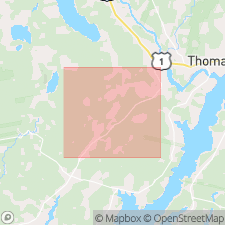
Waldoboro Granite consists of light-gray to buff medium- to coarse-grained muscovite granite. The pegmatites [focus of this report] occur within the Penobscot Formation. Clark Island and Waldoboro Granites crop out east and west of pegmatite occurrences. Age not stated.
Source: GNU records (USGS DDS-6; Reston GNULEX).
- Usage in publication:
-
- Waldoboro granitic pluton
- Modifications:
-
- Overview
- AAPG geologic province:
-
- New England province
Summary:
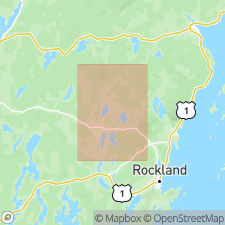
Waldoboro granitic pluton underlies the southwest corner of North Pond in Warren. West of map area, in quarry on north side of U.S. Rte 1, just east of Waldoboro, is a medium-grained buff-colored biotite granite, but near the contact on southwest shore of North Pond it contains muscovite. Devonian(?) on map. Has been suggested that the granite may be Acadian.
Source: GNU records (USGS DDS-6; Reston GNULEX).
- Usage in publication:
-
- Waldoboro Pluton Complex
- Modifications:
-
- Revised
- Overview
- Areal extent
- AAPG geologic province:
-
- New England province
Summary:
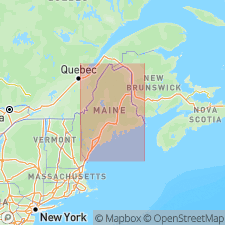
Complex represents a sequence of granitoid-pegmatoid intrusions. It surrounds Muscongus Bay in mid-coastal Maine. Seven major phases are identified in the Waldoboro Complex and exposures cover 377 square km.
[Revision is in conflict with nomenclature guidelines (NACSN, 1983, Art. 37[d]) --"Where the rock assemblage to be united under a single, formal name consists of diverse types of a single class of rock, as in many terranes that expose a variety of either intrusive igneous or high-grade metamorphic rocks, the term "intrusive suite," "plutonic suite," or "metamorphic suite" should be used, rather than the unmodified term "complex." Exceptions to this rule are the terms structural complex and volcanic complex."]
Source: GNU records (USGS DDS-6; Reston GNULEX).
For more information, please contact Nancy Stamm, Geologic Names Committee Secretary.
Asterisk (*) indicates published by U.S. Geological Survey authors.
"No current usage" (†) implies that a name has been abandoned or has fallen into disuse. Former usage and, if known, replacement name given in parentheses ( ).
Slash (/) indicates name conflicts with nomenclatural guidelines (CSN, 1933; ACSN, 1961, 1970; NACSN, 1983, 2005, 2021). May be explained within brackets ([ ]).