The National Geologic Map Database is migrating to a new infrastructure. We apologize for any service disruptions during this process.
|
|---|


- Usage in publication:
-
- Russell Creek limestone member
- Modifications:
-
- Original reference
- Dominant lithology:
-
- Limestone
- AAPG geologic province:
-
- Chautauqua platform
Summary:
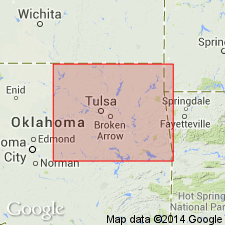
Pg. 191 (table 1). Russell Creek limestone member of Senora formation. Name applied to limestone that forms cap rock of the Mineral coal; underlies Broken Arrow coal. Age is Middle Pennsylvanian (Des Moines). Present in northeastern Oklahoma, southeastern Kansas, southwestern Missouri.
Type section: on Leep Farm on east bank of Russell Creek where it is flowing south in NE/4 SW/4 sec. 15, T. 29 N., R. 20 E., Craig Co., OK.
Source: US geologic names lexicon (USGS Bull. 1200, p. 3362).
- Usage in publication:
-
- Russell Creek limestone member
- Modifications:
-
- Overview
- AAPG geologic province:
-
- Chautauqua platform
Branson, C.C., 1955, Oklahoma stratigraphic names of recent date: Hopper, v. 15, no. 12, p. 135-138.
Summary:
Pg. 137. Russell Creek limestone member of Senora formation. Ferruginous clayey carbonaceous gray limestone, 10 inches to 2 feet thick in one bed; contains fusulinids. Age is Middle Pennsylvanian (Des Moines Series).
Source: US geologic names lexicon (USGS Bull. 1200, p. 3362).
For more information, please contact Nancy Stamm, Geologic Names Committee Secretary.
Asterisk (*) indicates published by U.S. Geological Survey authors.
"No current usage" (†) implies that a name has been abandoned or has fallen into disuse. Former usage and, if known, replacement name given in parentheses ( ).
Slash (/) indicates name conflicts with nomenclatural guidelines (CSN, 1933; ACSN, 1961, 1970; NACSN, 1983, 2005, 2021). May be explained within brackets ([ ]).