The National Geologic Map Database is migrating to a new infrastructure. We apologize for any service disruptions during this process.
|
|---|


- Usage in publication:
-
- Red Ant Schist
- Modifications:
-
- Named
- Dominant lithology:
-
- Quartzite
- Schist
- Phyllite
- AAPG geologic province:
-
- Sierra Nevada province
Summary:
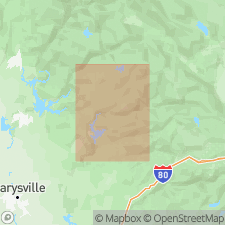
Name derivation not stated. Corresponds, in part, to Hietanen's (1981) "metamorphic rocks within the Melones fault zone". Type locality assigned along North Yuba River in sections 4, 33, 34, and 35, Sierra Co., northern CA. Occurs between Goodyears Creek fault and Downieville fault. Lithologically similar rocks included in this unit exposed in band around southern part of Paleozoic Devils Gate ophiolite [informal]. Consists of metasedimentary and metavolcanic rocks with disharmonically folded quartz schist predominant. Quartzite layers (2 to 20 mm thick) separated by comparably thick black mica schist and phyllite layers are all cut by deformed quartz veins. Metavolcanics rocks occur as greenstones with local blueschist minerals including crossite (Hietanen, 1981) or crossite and glaucophane (Schweickert and others, 1980). Serpentinite lenses in the Red Ant are chiefly outliers of Paleozoic Feather River peridotite [informal]. Thickness not stated. Age of protolith not known. K-Ar data suggest blueschist facies metamorphism took place before 174 Ma and possibly before 190 Ma Schweickert and others, 1980). The Red Ant, probable remnant of early Mesozoic subduction complex (Schweickert and others, 1980) is southernmost representative of discontinuous belt of early Mesozoic blueschist facies rocks extending north through Klamath Mountains and into north-central Oregon (Hotz and others, 1977). Report includes stratigraphic columns, geologic maps, and cross sections.
Source: GNU records (USGS DDS-6; Menlo GNULEX).
For more information, please contact Nancy Stamm, Geologic Names Committee Secretary.
Asterisk (*) indicates published by U.S. Geological Survey authors.
"No current usage" (†) implies that a name has been abandoned or has fallen into disuse. Former usage and, if known, replacement name given in parentheses ( ).
Slash (/) indicates name conflicts with nomenclatural guidelines (CSN, 1933; ACSN, 1961, 1970; NACSN, 1983, 2005, 2021). May be explained within brackets ([ ]).