The National Geologic Map Database is migrating to a new infrastructure. We apologize for any service disruptions during this process.
|
|---|


- Usage in publication:
-
- Mule Ear Spring Tuff [Member]
- Modifications:
-
- Geochronologic dating
- AAPG geologic province:
-
- Permian basin
Summary:
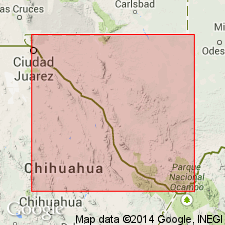
Pg. 24. Mule Ear Spring Tuff [Member] of Chisos Formation. Rhyolite samples from Castolon and Santana Mesa quadrangles, Brewster County, southwestern Texas, yielded K-Ar ages 35.0 +/-6.0 Ma (material unknown) and 33.7 +/-0.7 Ma (alkali feldspar), respectively. Rhyolite sample (=Matadero tuff of Chuchla, 1981, and Gregory, 1981) from Chihuahua, Mexico, yielded a K-Ar age of 34.1 +/-0.7 Ma (alkali feldspar). Data from R.J. Chuchla, 1981 (Univ. Texas-Austin, MS thesis, 199 p.), J.L. Gregory, 1981 (Univ. Texas-Austin, MS thesis, 78 p.), C.D. Henry and J.G. Price, 1984 (Jour. Geophysical Res., v. 89, p. 8765-8786), and R.A. Maxwell and others, 1967 (Univ. Texas-Austin Pub. 6711, 320 p.); ages recalculated using decay constants of Steiger and Jager, 1977 (Earth Planet. Sci. Letters, v. 36, p. 359-362).
[Age considered Oligocene; Eocene-Oligocene boundary 36.6 (38-34) Ma (from Geologic Names Committee, USGS, 1983 ed. geol. time scale, with additions from N.J. Snelling, 1985, The Geol. Soc. Mem., no. 10).]
Source: Publication.
For more information, please contact Nancy Stamm, Geologic Names Committee Secretary.
Asterisk (*) indicates published by U.S. Geological Survey authors.
"No current usage" (†) implies that a name has been abandoned or has fallen into disuse. Former usage and, if known, replacement name given in parentheses ( ).
Slash (/) indicates name conflicts with nomenclatural guidelines (CSN, 1933; ACSN, 1961, 1970; NACSN, 1983, 2005, 2021). May be explained within brackets ([ ]).