

- Usage in publication:
-
- McAfee Breccia Dike Complex
- Modifications:
-
- First used
- Dominant lithology:
-
- Breccia
- Gneiss
- Marble
- AAPG geologic province:
-
- Appalachian basin
Summary:
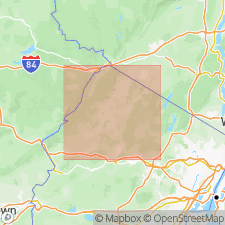
The McAfee Breccia Dike Complex occurs at an isolated outcrop within the Franklin Band of Marbles, on Rte 94 in McAfee, NJ. Forms a fault scarp on the western block of the East Fault, which generally separates the Franklin Marble and Byram Metamorphic Suite from overlying Paleozoic carbonate outliers. The dike complex consists of a network of connected dikes with an overall northeast to southwest trend. The dike rocks are a breccia composed of angular clasts of microcline gneiss and Franklin Marble, set in a carbonate matrix. They range in size from 2 cm to 2 m wide and up to 50 m long. Age of emplacement is estimated from examination of cross-cutting relationships. The McAfee is cut by a lamprophyre dike identified as part of the Beemerville Nepheline Syenite, dated at 444+/-22 Ma (Late Ordovician) by Ratcliffe (1981). The intrusion by the McAfee, then, is placed during the late Taconic Orogeny.
Source: GNU records (USGS DDS-6; Reston GNULEX).
For more information, please contact Nancy Stamm, Geologic Names Committee Secretary.
Asterisk (*) indicates published by U.S. Geological Survey authors.
"No current usage" (†) implies that a name has been abandoned or has fallen into disuse. Former usage and, if known, replacement name given in parentheses ( ).
Slash (/) indicates name conflicts with nomenclatural guidelines (CSN, 1933; ACSN, 1961, 1970; NACSN, 1983, 2005, 2021). May be explained within brackets ([ ]).