

- Usage in publication:
-
- Jansen Creek Member*
- Modifications:
-
- Named
- Dominant lithology:
-
- Sandstone
- Conglomerate
- AAPG geologic province:
-
- Olympic Mountains province
Summary:
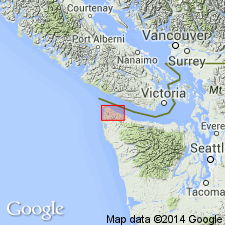
Named for exposures at mouth of Jansen Creek, SE/4 SE/4 sec.26 T33N R14W. Type section: sea cliffs, wave-cut platforms, and sea stacks from headland 0.5 km east of Bullman Creek to point 0.7 km southeast of Brush Point, NE/4 NW/4 sec.6 T32N R13W, Strait of Juan de Fuca, Clallam Co, WA. Is youngest member (of 6) of Makah Formation. Consists of basaltic sandstone and conglomerate. Forms deformed, thick-bedded, fossiliferous, cliff-forming, shallow-water olistostrome deposits. Is 200 m thick. Lies 250 m above Third Beach Member (new) (Makah Formation); overlies and underlies, with sharp contacts, unnamed undeformed deep-water marine strata of Makah Formation. Is early Oligocene age.
Source: GNU records (USGS DDS-6; Menlo GNULEX).
For more information, please contact Nancy Stamm, Geologic Names Committee Secretary.
Asterisk (*) indicates published by U.S. Geological Survey authors.
"No current usage" (†) implies that a name has been abandoned or has fallen into disuse. Former usage and, if known, replacement name given in parentheses ( ).
Slash (/) indicates name conflicts with nomenclatural guidelines (CSN, 1933; ACSN, 1961, 1970; NACSN, 1983, 2005, 2021). May be explained within brackets ([ ]).