The National Geologic Map Database is migrating to a new infrastructure. We apologize for any service disruptions during this process.
|
|---|


- Usage in publication:
-
- Gene Canyon Formation
- Modifications:
-
- Overview
- Dominant lithology:
-
- Sandstone
- Volcanics
- AAPG geologic province:
-
- Basin-and-Range province
Summary:
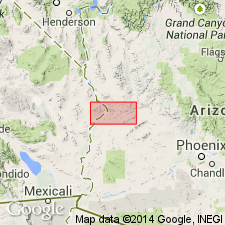
Type Area: Gene Canyon, east Whipple Mountains, Gene Wash quad, San Bernardino Co, CA. Named by Ransome (1931) in his geologic reconnaissance for CA aqueduct project. Composed of interbedded red-to-buff sandstone, amygdaloidal andesitic(?) volcanic rocks, coarse debris flows of crystalline rocks, and siltstone (Kemnitzer, 1937) at type area. Limestone is present elsewhere. Is 585 m thick. Is unit in allochthonous upper-plate assemblage separated from lower-plate assemblage by subhorizontal detachment fault. Overlies upper-plate crystalline basement rocks; unconformably underlies Copper Basin Formation or Osborne Wash Formation. Is late Oligocene(?) to early Miocene age based on artiodactyl (giant pig) track found by Kemnitzer (1937).
Source: GNU records (USGS DDS-6; Menlo GNULEX).
For more information, please contact Nancy Stamm, Geologic Names Committee Secretary.
Asterisk (*) indicates published by U.S. Geological Survey authors.
"No current usage" (†) implies that a name has been abandoned or has fallen into disuse. Former usage and, if known, replacement name given in parentheses ( ).
Slash (/) indicates name conflicts with nomenclatural guidelines (CSN, 1933; ACSN, 1961, 1970; NACSN, 1983, 2005, 2021). May be explained within brackets ([ ]).