

- Usage in publication:
-
- Fite Ranch Sandstone Member*
- Modifications:
-
- Named
- Dominant lithology:
-
- Sandstone
- AAPG geologic province:
-
- Orogrande basin
Summary:
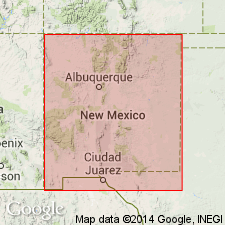
Named as the upper member of Tres Hermanos Formation (raised in stratigraphic rank) for Fite Ranch, 1 mi south of Carthage, Socorro Co, NM in Orogrande basin. Type section measured in SE1/4 SE1/4 sec 8 and NE1/4 NE1/4 sec 17, T5S, R2E where the member is composed of light-gray to brown, fine-grained sandstone with a lesser amount of siltstone that total 75 ft (22.7 m) thick. The sandstones may be poorly bedded, burrowed, bioturbated, moderately to well sorted. Some beds are flat bedded; some are ripple marked. Is much thinner in most places and is locally absent. Overlies Carthage Member of Tres Hermanos; underlies D-Cross Tongue of Mancos Shale. Is fossiliferous (oysters). Deposited in earliest late Turonian (Late Cretaceous) time as a coastal barrier sandstone. Is equivalent to Juana Lopez Limestone Member.
Source: GNU records (USGS DDS-6; Denver GNULEX).
For more information, please contact Nancy Stamm, Geologic Names Committee Secretary.
Asterisk (*) indicates published by U.S. Geological Survey authors.
"No current usage" (†) implies that a name has been abandoned or has fallen into disuse. Former usage and, if known, replacement name given in parentheses ( ).
Slash (/) indicates name conflicts with nomenclatural guidelines (CSN, 1933; ACSN, 1961, 1970; NACSN, 1983, 2005, 2021). May be explained within brackets ([ ]).