

- Usage in publication:
-
- Fairhaven Till
- Modifications:
-
- Named
- Dominant lithology:
-
- Till
- AAPG geologic province:
-
- Cincinnati arch
Summary:
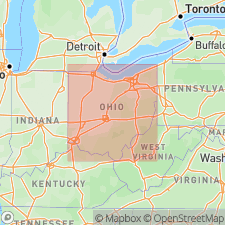
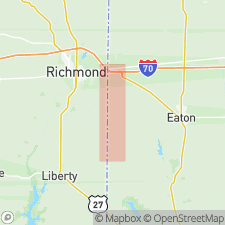
A single till has been identified between the New Paris and Sidney interstadial units of Gooding (1963) and it has been designated the Fairhaven Till. The till is characteristically brown and has a northeast fabric. Earlier studies included this unit in the Fayette Till. The Fairhaven has been identified as far south as the villages of Fairhaven and Camden and as far east as Bantas Fork, east of Eaton. The age is a problem directly related to the length of the Sidney Interstade. The Fairhaven is either early or middle Wisconsinan.
Source: GNU records (USGS DDS-6; Reston GNULEX).
- Usage in publication:
-
- Fairhaven Till
- Modifications:
-
- Overview
- AAPG geologic province:
-
- Cincinnati arch
Summary:
The Huron-Erie lobe Fairhaven Till overlies the Whitewater Till and was assigned a middle Wisconsinan age by Gooding (1975) consistent with a single finite age of 44,800+/-700 BP from underlying sediments. [Gooding does not refer to the Fairhaven by name.] However, absence of a well-developed paleosol between the Whitewater and Fairhaven indicates an early Wisconsin age for both tills. Author expresses the opinion (Appendix 1) that the Fairhaven and Whitewater as stratigraphic units, are inadequately defined. [Though author is a USGS scientist, there is no evidence to indicate that manuscript was reviewed by the GNU.]
Source: GNU records (USGS DDS-6; Reston GNULEX).
- Usage in publication:
-
- Fairhaven Till
- Modifications:
-
- Age modified
- AAPG geologic province:
-
- Cincinnati arch
Summary:
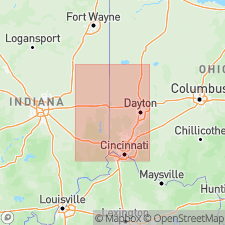
The Fairhaven Till at its type locality overlies a discontinuous sand and the Whitewater Till. Nonglacial organic sediments containing mollusks and plant remains separate the Fairhaven from the Whitewater at several sites in southwestern OH and southeastern IN. Alloisoleucine/isoleucine ratios obtained from these fossils indicate a pre-Wisconsinan age for both tills, which previously had been assigned an early or middle Wisconsinan age. It is here suggested that the weathering profile at the top of the Fairhaven, called Sidney by Goldthwait and others (1981), correlates with the Sangamon soil of IL. The Fairhaven, then, is Illinoian and the Whitewater, pre-Illinoian.
Source: GNU records (USGS DDS-6; Reston GNULEX).
For more information, please contact Nancy Stamm, Geologic Names Committee Secretary.
Asterisk (*) indicates published by U.S. Geological Survey authors.
"No current usage" (†) implies that a name has been abandoned or has fallen into disuse. Former usage and, if known, replacement name given in parentheses ( ).
Slash (/) indicates name conflicts with nomenclatural guidelines (CSN, 1933; ACSN, 1961, 1970; NACSN, 1983, 2005, 2021). May be explained within brackets ([ ]).