

- Usage in publication:
-
- Emporia blue limestone
- Modifications:
-
- Original reference
- Dominant lithology:
-
- Limestone
- AAPG geologic province:
-
- Forest City basin
Summary:
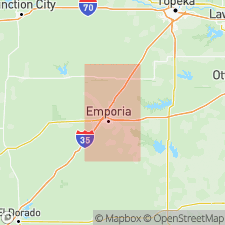
Pg. 100. Emporia blue limestone. Hard blue limestone, 3 feet thick, with 6 inch layer at top that makes a good flagstone extensively used in Emporia, eastern Kansas. In Lyon County separated from underlying Burlingame limestone by 44.5 feet of shales with two thin limestones [Humphrey shale of A.J. Smith 1905 report] and separated from overlying Emporia limestone by about 64 feet of shales with some thin limestones and one coal bed [Olpe shale restricted of A.J. Smith 1905 report]. Age is Pennsylvanian.
Named from Emporia, Lyon Co., eastern KS.
Source: US geologic names lexicon (USGS Bull. 896, p. 687).
- Usage in publication:
-
- Emporia blue limestone†
- Modifications:
-
- Abandoned
- AAPG geologic province:
-
- Forest City basin
Summary:
†Emporia blue limestone. Preoccupied. Discarded by A.J. Smith in 1905 (Kansas Acad. Sci. Trans., v. 19, p. 150-154) and replaced with Reading blue limestone.
Source: US geologic names lexicon (USGS Bull. 896, p. 687); GNC KS-NE Pennsylvanian Corr. Chart, sheet 2, Oct. 1936.
For more information, please contact Nancy Stamm, Geologic Names Committee Secretary.
Asterisk (*) indicates published by U.S. Geological Survey authors.
"No current usage" (†) implies that a name has been abandoned or has fallen into disuse. Former usage and, if known, replacement name given in parentheses ( ).
Slash (/) indicates name conflicts with nomenclatural guidelines (CSN, 1933; ACSN, 1961, 1970; NACSN, 1983, 2005, 2021). May be explained within brackets ([ ]).