The National Geologic Map Database is migrating to a new infrastructure. We apologize for any service disruptions during this process.
|
|---|


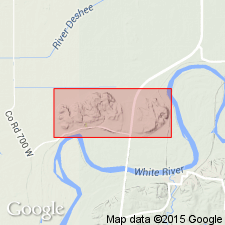
- Usage in publication:
-
- Dicksburg Hills sandstone
- Modifications:
-
- [Areal extent]
- AAPG geologic province:
-
- Illinois basin
Summary:
Dicksburg Hills sandstone. Overlies Hazleton Bridge formation (new).
Source: US geologic names lexicon (USGS Bull. 1200, p. 1116).
- Usage in publication:
-
- Dicksburg Hills sandstone
- Modifications:
-
- Original reference
- Dominant lithology:
-
- Sandstone
- AAPG geologic province:
-
- Illinois basin
Summary:
Pg. 131, 133 (flg. 2), 134. Dicksburg Hills sandstone. Massive coarse-grained micaceous friable cross-bedded sandstone. Thickness at type locality 50 feet. Unconformably overlies Hazelton Bridge formation; underlies Parkers formation. To the south, the sandstone was mapped as a part of Fuller's Inglefield formation (USGS Geol. Atlas of the US, Ditney and Patoka folios). Type locality designated. Age is Late Pennsylvanian.
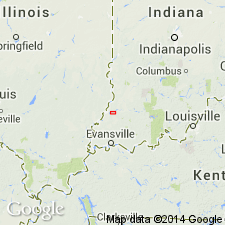
Type locality: in "The Rock Bluffs," in SW/4 sec. 18, T. 1 N., R. 10 W., in northeastern part of the western hill of the Dicksburg Hills, Knox Co., southwestern IN.
Source: US geologic names lexicon (USGS Bull. 1200, p. 1116).
For more information, please contact Nancy Stamm, Geologic Names Committee Secretary.
Asterisk (*) indicates published by U.S. Geological Survey authors.
"No current usage" (†) implies that a name has been abandoned or has fallen into disuse. Former usage and, if known, replacement name given in parentheses ( ).
Slash (/) indicates name conflicts with nomenclatural guidelines (CSN, 1933; ACSN, 1961, 1970; NACSN, 1983, 2005, 2021). May be explained within brackets ([ ]).