The National Geologic Map Database is migrating to a new infrastructure. We apologize for any service disruptions during this process.
|
|---|


- Usage in publication:
-
- Debris Dam sandstone
- Modifications:
-
- Original reference
- Dominant lithology:
-
- Sandstone
- Shale
- AAPG geologic province:
-
- Santa Maria basin
Summary:
Pg. 1730 (fig. 2), 1734 (fig. 4), 1739-1743. Debris Dam sandstone. Lower 750 feet of type section consists of sandstone members 60 to 330 feet thick alternating with shale members 50 to 100 feet thick; middle 850 feet is massive cliff-forming sandstone that is predominantly light-gray; upper 600 feet is alternating shales and sandstones, members averaging about 150 feet in thickness. South of Santa Ynez fault, includes Romero conglomerate lentils (new). In type area, underlies Pendola shale (new); southwest of type section, Pendola is cut out and the Debris Dam is unconformably overlain by middle Eocene Juncal formation. Gradationally overlies unnamed Cretaceous shale unit; base of Debris Dam arbitrarily selected where sandstone first predominates over shale in the transitional sequence. Age is Late Cretaceous.
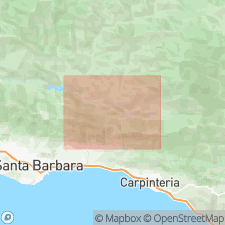
Type locality: small canyon that drains westward to Agua Caliente Canyon about 1.5 mi northeast of Pendola Guard Station and 1-1/8 mi south of Big Caliente Debris Dam, Santa Barbara Co., southern CA. Base of section 6,200 ft S. 1 deg. E. of Big Caliente Dam, and top is 6,700 ft S. of 23 deg. E. of dam. Formation forms part of [Agua] Caliente anticline. To northwest of type section, beds extend past Big Caliente Debris Dam to northern limit of area; southwestward, they extend approximately 1 mi where they disappear beneath Juncal formation; seemingly they reappear south of Santa Ynez fault in an elongate east-west-trending belt; however, correlation here is uncertain because of lack of fossils and occurrence of Romero conglomerate lentils.
Source: US geologic names lexicon (USGS Bull. 1200, p. 1060-1061).
For more information, please contact Nancy Stamm, Geologic Names Committee Secretary.
Asterisk (*) indicates published by U.S. Geological Survey authors.
"No current usage" (†) implies that a name has been abandoned or has fallen into disuse. Former usage and, if known, replacement name given in parentheses ( ).
Slash (/) indicates name conflicts with nomenclatural guidelines (CSN, 1933; ACSN, 1961, 1970; NACSN, 1983, 2005, 2021). May be explained within brackets ([ ]).