The National Geologic Map Database is migrating to a new infrastructure. We apologize for any service disruptions during this process.
|
|---|


- Usage in publication:
-
- Crone Gulch Andesite*
- Modifications:
-
- Named
- Dominant lithology:
-
- Andesite
- AAPG geologic province:
-
- Great Basin province
Summary:
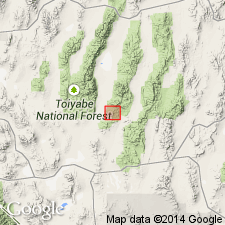
Unit is named for exposures in its type locality in Crone Gulch, 4 km northeast of Manhattan, SE/4 sec. 10, T8N R44E, Manhattan 7.5' quad, Nye Co, NV. Rocks north of Manhattan formerly called Gilbert Andesite by Ferguson and others (1953). Forms stock about 3 x 1 km emplaced in Round Rock and Diamond King Formations. Andesite is olive-brown porphyritic, containing about 25% labradorite in form of laths as long as 4 mm. K-Ar method on plagioclase and fission track method on apatite yielded 22 Ma (Shawe and others, 1986). Age is considered latest Oligocene on basis of geologic inference (Shawe and Snyder, [1988]) or earliest Miocene on basis of isotopic analyses.
Source: GNU records (USGS DDS-6; Menlo GNULEX).
- Usage in publication:
-
- Crone Gulch Andesite*
- Modifications:
-
- Age modified
- Geochronologic dating
- AAPG geologic province:
-
- Great Basin province
Summary:
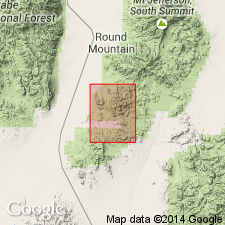
Age of the Crone Gulch Andesite is revised from latest Oligocene or earliest Miocene to: Oligocene based on radiometric data and regional stratigraphic relations.
Source: GNU records (USGS DDS-6; Menlo GNULEX).
For more information, please contact Nancy Stamm, Geologic Names Committee Secretary.
Asterisk (*) indicates published by U.S. Geological Survey authors.
"No current usage" (†) implies that a name has been abandoned or has fallen into disuse. Former usage and, if known, replacement name given in parentheses ( ).
Slash (/) indicates name conflicts with nomenclatural guidelines (CSN, 1933; ACSN, 1961, 1970; NACSN, 1983, 2005, 2021). May be explained within brackets ([ ]).