

- Usage in publication:
-
- Cottonwood Creek Rhyolite
- Modifications:
-
- Named
- Dominant lithology:
-
- Rhyolite
- AAPG geologic province:
-
- Snake River basin
Summary:
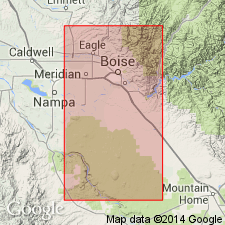
Probably named for local stream. Assigned to Miocene Idavada Group (revised). Occurs in northeast margin of western Snake River Plain near Boise, Ada Co, southwestern ID. Crops out as phyric stony rhyolite flow in Rocky Canyon 2 mi NNE of Table Rock 43 deg 36' N, 116 deg 10' W; NE1/4, SE1/4, S6, T3N, R3E; Boise South 7.5' quad. Consists of sparsely phyric (5% sanidine, 1-2% plagioclase) lava with vertical and contorted flow banding, basal crumble or flow breccia, and absence of remnant pyroclastic textures (Bonnichsen and Kauffman, 1987). Thickness is 120 m (W. L. Burnham, personal communication). Overlies Tertiary interlayered Plinian air-fall pumice and arkosic sands. Overlain by Miocene Quarry View Park Rhyodacite (new). Correlates with Miocene Table Rock Road Rhyolite (new), which is thought to come from common magma source. Age is Miocene and, based on field mapping and borehole data, deemed oldest exposed unit in Boise front (Wood and Burnham, 1983, 1987). Its K-Ar (sanidine) 11.3+/-0.3 Ma date correlates nicely with the 9-14 Ma age range shown for Idavada Group in southwestern ID (Armstrong and others, 1980) and (Leeman, 1980). Report includes geologic map and stratigraphic column.
Source: GNU records (USGS DDS-6; Denver GNULEX).
For more information, please contact Nancy Stamm, Geologic Names Committee Secretary.
Asterisk (*) indicates published by U.S. Geological Survey authors.
"No current usage" (†) implies that a name has been abandoned or has fallen into disuse. Former usage and, if known, replacement name given in parentheses ( ).
Slash (/) indicates name conflicts with nomenclatural guidelines (CSN, 1933; ACSN, 1961, 1970; NACSN, 1983, 2005, 2021). May be explained within brackets ([ ]).