

- Usage in publication:
-
- City Ledge
- Modifications:
-
- Original reference
- Dominant lithology:
-
- Sandstone
- AAPG geologic province:
-
- Appalachian basin
Summary:
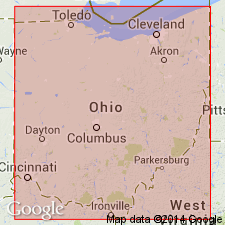
Pg. 66, 67, 68. City Ledge. Famous stratum of sandstone, 3 feet 5 inches to 4 feet 6 inches thick, called "city ledge." Separated from Waverly black slate below by 5 feet 4 inches of clay and shale. Overlain by 5.5 feet of soft bluish shale.
Quarried at Rockville, [Stark Co.], and Buena Vista, [Fayette Co.], OH. [Nongeographic name.]
Source: US geologic names lexicon (USGS Bull. 896, p. 448).
- Usage in publication:
-
- City Ledge sandstone†
- Modifications:
-
- Abandoned
- AAPG geologic province:
-
- Appalachian basin
Summary:
†City Ledge sandstone (in Cuyahoga formation). Nongeographic name. The bed belongs in Buena Vista sandstone member of Cuyahoga formation.
Source: US geologic names lexicon (USGS Bull. 896, p. 448).
For more information, please contact Nancy Stamm, Geologic Names Committee Secretary.
Asterisk (*) indicates published by U.S. Geological Survey authors.
"No current usage" (†) implies that a name has been abandoned or has fallen into disuse. Former usage and, if known, replacement name given in parentheses ( ).
Slash (/) indicates name conflicts with nomenclatural guidelines (CSN, 1933; ACSN, 1961, 1970; NACSN, 1983, 2005, 2021). May be explained within brackets ([ ]).