

- Usage in publication:
-
- Breakwater quartzite
- Modifications:
-
- Original reference
- AAPG geologic province:
-
- Wisconsin arch
Summary:
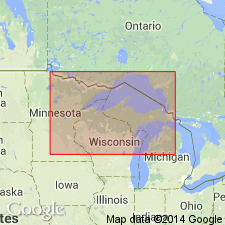
Pg. 4. Breakwater quartzite is tentatively assigned to Goodrich epoch [being correlated with Goodrich quartzite of Marquette district]. Age is pre-Cambrian (upper Huronian).
Named from its location near Breakwater Falls on Pine River, Florence Co., WI.
Source: US geologic names lexicon (USGS Bull. 896, p. 257).
- Usage in publication:
-
- Breakwater
- Modifications:
-
- Not used
- AAPG geologic province:
-
- Lake Superior region
Summary:
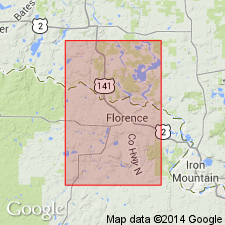
Is not used in this report in vicinity of Florence, Florence Co, WI (Lake Superior region). No explanation is given. "The Pine River (formerly known as "Breakwater") quartzite conglomerate consists of a lower conglomerate, middle cross-stratified quartzite and pebbly quartzite, and an upper conglomerate. Each sub-unit thins to the northwest, with total thickness ranging from 600 feet to 150 feet in a distance of 3 miles." The Pine River unit is designated as an informal member "of the Michigamme Slate, a formation in the Baraga Group of the Middle Precambrian Animikie Series of northern Michigan."
Source: GNU records (USGS DDS-6; Denver GNULEX).
For more information, please contact Nancy Stamm, Geologic Names Committee Secretary.
Asterisk (*) indicates published by U.S. Geological Survey authors.
"No current usage" (†) implies that a name has been abandoned or has fallen into disuse. Former usage and, if known, replacement name given in parentheses ( ).
Slash (/) indicates name conflicts with nomenclatural guidelines (CSN, 1933; ACSN, 1961, 1970; NACSN, 1983, 2005, 2021). May be explained within brackets ([ ]).