

- Usage in publication:
-
- Black Dragon Member
- Modifications:
-
- Original reference
- AAPG geologic province:
-
- Paradox basin
Summary:
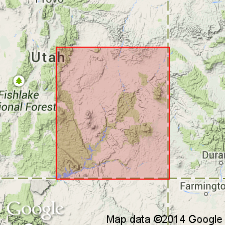
Pg. 13-22. Black Dragon Member of Moenkopi Formation. Consists of slope-forming, laminated and thin-bedded, red and gray sandstone and siltstone. Thickness at type 63 m. Overlies Kaibab Formation; underlies Sinbad Limestone Member of the Moenkopi Formation. Age is Early Triassic.
Type section: Black Dragon Canyon in northeast section of San Rafael Swell, in T. 21 S., R. 13 E., Emery Co., southeastern UT.
Source: US geologic names lexicon (USGS Bull. 1520, p. 30-31).
- Usage in publication:
-
- Black Dragon Member
- Modifications:
-
- Areal extent
- AAPG geologic province:
-
- Paradox basin
Summary:
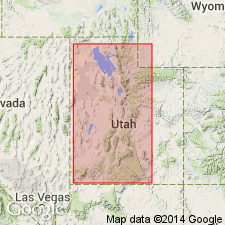
Black Dragon Member of Moenkopi Formation. In the Capitol Reef and San Rafael areas, Emery County, Utah, unconformably overlies Black Box Dolomite (new). Age is Triassic.
Source: Modified from GNU records (USGS DDS-6; Denver GNULEX).
For more information, please contact Nancy Stamm, Geologic Names Committee Secretary.
Asterisk (*) indicates published by U.S. Geological Survey authors.
"No current usage" (†) implies that a name has been abandoned or has fallen into disuse. Former usage and, if known, replacement name given in parentheses ( ).
Slash (/) indicates name conflicts with nomenclatural guidelines (CSN, 1933; ACSN, 1961, 1970; NACSN, 1983, 2005, 2021). May be explained within brackets ([ ]).