The National Geologic Map Database is migrating to a new infrastructure. We apologize for any service disruptions during this process.
|
|---|


- Usage in publication:
-
- Bays-of-Maine Complex
- Modifications:
-
- Original reference
- Dominant lithology:
-
- Gabbro
- Granite
- AAPG geologic province:
-
- New England province
Summary:
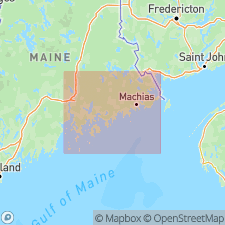
Pg. 883-887. Bays-of-Maine Complex. Name applied to belt of igneous rocks that underlies northeastern half of Maine coastal area. The complex, of middle Paleozoic, is bimodal and is composed of predominantly layered gabbroic rocks and granites. Trends roughly parallel to regional structure for at least 175 miles, and total length probably exceeds 300 miles. Flanking complex on northwest is belt of low- to medium-grade metamorphic rocks of pre-Middle Silurian age and composed of Ellsworth Schist and Charlotte Group (type area in New Brunswick). Toward southeast flank and in part covering the complex is a sequence of Middle and Upper Silurian volcanic and associated sedimentary rocks. Near Maine-New Brunswick border, the Silurian rocks and some of the granitic rocks are unconformably overlain by Upper Devonian Perry Formation.
Extends from Maine-New Brunswick border southwest at least as far as
Penobscot Bay.
Source: US geologic names lexicon (USGS Bull. 1350, p. 50-51).
For more information, please contact Nancy Stamm, Geologic Names Committee Secretary.
Asterisk (*) indicates published by U.S. Geological Survey authors.
"No current usage" (†) implies that a name has been abandoned or has fallen into disuse. Former usage and, if known, replacement name given in parentheses ( ).
Slash (/) indicates name conflicts with nomenclatural guidelines (CSN, 1933; ACSN, 1961, 1970; NACSN, 1983, 2005, 2021). May be explained within brackets ([ ]).