

- Usage in publication:
-
- Bat Mountain Formation
- Modifications:
-
- Original reference
- Dominant lithology:
-
- Fanglomerate
- Conglomerate
- AAPG geologic province:
-
- Great Basin province
Summary:
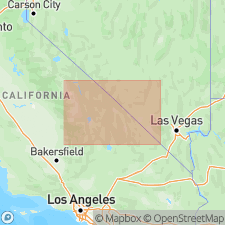
The Bat Mountain Formation, here named, is in the southeastern end of the Funeral Mountains in the Death Valley region of Inyo County, California. Denny and Drewes (1965) divided the formation into an informal lower unit, which they called the upper fanglomerate, and an informal upper unit, which they called the upper conglomerate. Their upper fanglomerate is here referred to as the conglomerate member and their upper conglomerate as the sandstone member. The conglomerate member consists of poorly sorted, angular clasts of Proterozoic and Paleozoic carbonate and siliceous rocks in a sand to clay matrix, which is gray in the lower part and red in the upper part of the member. The sandstone member consists of reddish-brown to brown fining-upward cycles, conglomeratic at the base and silty at the top, and represents stream deposits marginal to the alluvial fan deposits of the conglomerate member. The sandstone member grades laterally and vertically down into the conglomerate member. The Bat Mountain unconformably overlies algal limestone and is exposed at the surface. Thickness of the conglomerate member ranges from 200 to 1,000 feet. Age is middle(?) Miocene based on the ages of tuffs in the Artist Drive Formation.
Type locality: exposures along crest and southeastern flank of Bat Mountain, southeastern Funeral Mountains, Ash Meadows 15-min quadrangle, Inyo Co., CA.
Source: US geologic names lexicon (USGS Bull. 1565, p. 21-22).
For more information, please contact Nancy Stamm, Geologic Names Committee Secretary.
Asterisk (*) indicates published by U.S. Geological Survey authors.
"No current usage" (†) implies that a name has been abandoned or has fallen into disuse. Former usage and, if known, replacement name given in parentheses ( ).
Slash (/) indicates name conflicts with nomenclatural guidelines (CSN, 1933; ACSN, 1961, 1970; NACSN, 1983, 2005, 2021). May be explained within brackets ([ ]).