The National Geologic Map Database is migrating to a new infrastructure. We apologize for any service disruptions during this process.
|
|---|


- Usage in publication:
-
- Banzet Formation
- Modifications:
-
- Named
- Dominant lithology:
-
- Shale
- Siltstone
- Limestone
- AAPG geologic province:
-
- Cherokee basin
- Chautauqua platform
Summary:
Banzet Formation of the Cherokee Group. The interval of shales, siltstones, thin limestones, thin coals, and lenticular, discontinuous sandstones found in repetitive sequences between the top of the Ardmore Limestone and the base of the Excello Shale in southeastern Kansas and northeastern Oklahoma is here named the Banzet Formation of the Cherokee Group. Includes the Bevier, Lagonda, and Mulky Members, here reduced from formation rank, and the Bevier coal bed in the Bevier Member, the Iron Post coal bed in the Lagonda Member, and the Kinnison Shale Bed, Breezy Hill Limestone Bed, and Mulky coal bed in the Mulky Member. The Kinnison and Breezy Hill are reduced from members of the Mulky Formation. Age is Middle Pennsylvanian (Desmoinesian).
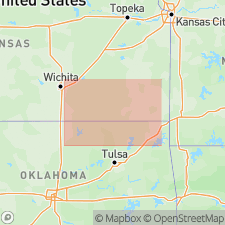
Type area: 11,000 sq mi between T. 26 S. (KS) and T. 22 N. (OK), and between R. 2 E. and R. 23 E. Origin of name not stated by author.
Source: US geologic names lexicon (USGS Bull. 1565, p. 20).
- Usage in publication:
-
- /Banzet formation (informal)
- Modifications:
-
- Reference
- Revised
- Dominant lithology:
-
- Shale
- Limestone
- Sandstone
- AAPG geologic province:
-
- Chautauqua platform
- Cherokee basin
- Forest City basin
Summary:
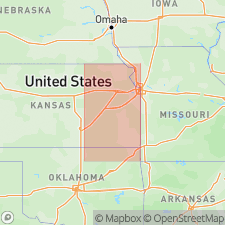
Pg. 7+. /Banzet formation (informal) of Cherokee Group. Presents an informal classification for upper part of Cherokee Group of eastern Kansas and northeastern Oklahoma; revised from Krumme (Oklahoma Geol. Survey Bull., no. 131, 1981) and Denesen (1985). [Term "Formation" is applied to formal nomenclature (CSN, 1933; ACSN, 1961, 1970; NACSN, 1983, 2005, 2021).]
At "type section" [reference section], upper part of Banzet includes (descending) informal Breezy Hill limestone and Iron Post coal beds. In eastern Kansas, the Banzet is informally subdivided into (descending): (1) Mulky member, includes Mulky coal bed at top, Breezy Hill limestone bed, and Kinnison shale bed at base; (2) Lagonda member, top = Iron Post coal bed; and (3) Bevier member, top = Bevier coal bed. Lies above informal /Verdigris formation of Cherokee Group and below Fort Scott Limestone of Marmaton Group. Fossils. Age is Middle Pennsylvanian (Desmoinesian).
[Reference section]: west of Welch, in roadcut (trenched 1982) along OK Highway 10, in SW/4 SW/4 sec. 30, T. 28 N., R. 20 E., Craig Co., northeastern OK.
[†Banzet Formation of Cherokee Group not adopted by the OK and KS Geol. Surveys. In Oklahoma, rocks included in (descending) Wetumka Shale, Calvin Sandstone, and Senora Formation (see Fay, 1997, Oklahoma Geol. Survey OFR-2-97). In Kansas, rocks included in Cabaniss Formation (see Kansas stratigraphic chart, 2010, updated from Kansas Geol. Survey Bull. no. 189).]
Source: Publication.
For more information, please contact Nancy Stamm, Geologic Names Committee Secretary.
Asterisk (*) indicates published by U.S. Geological Survey authors.
"No current usage" (†) implies that a name has been abandoned or has fallen into disuse. Former usage and, if known, replacement name given in parentheses ( ).
Slash (/) indicates name conflicts with nomenclatural guidelines (CSN, 1933; ACSN, 1961, 1970; NACSN, 1983, 2005, 2021). May be explained within brackets ([ ]).