The National Geologic Map Database is migrating to a new infrastructure. We apologize for any service disruptions during this process.
|
|---|


- Usage in publication:
-
- Bald Mountain tonalite
- Modifications:
-
- Original reference
- Dominant lithology:
-
- Tonalite
- AAPG geologic province:
-
- Blue Mountains province
Summary:
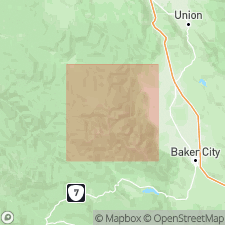
Pg. 197-204. Bald Mountain tonalite. Occupies 131 of 171 sq mi of batholith. Medium-grained, fairly uniform pale-blue-gray tonalite with sprinkling of dark minerals. Intrudes Permian sedimentary and volcanic sequence and Triassic ultramafic-gabbroic series. Intruded by Mount Ruth leucogranodiorite and Red Mountain leucogranodiorite (both new). Surrounds Badger Butte quartz-biotite norite (new). Grades into Anthony Lake granodiorite (new) near center of batholith; this transition zone is intruded by Elk Peak quartz monzonite (new). Age is Early Cretaceous(?).
Characteristically exposed on Mount Ireland (formerly called Bald Mountain), in sec. 29, T. 8 S., R. 36 E., Mt. Ireland 7.5-min quadrangle, Grant Co., OR. Named from Bald Mountain batholith, of which it is major rock component.
Source: US geologic names lexicon (USGS Bull. 1200, p. 202); GNU records (USGS DDS-6; Menlo GNULEX).
For more information, please contact Nancy Stamm, Geologic Names Committee Secretary.
Asterisk (*) indicates published by U.S. Geological Survey authors.
"No current usage" (†) implies that a name has been abandoned or has fallen into disuse. Former usage and, if known, replacement name given in parentheses ( ).
Slash (/) indicates name conflicts with nomenclatural guidelines (CSN, 1933; ACSN, 1961, 1970; NACSN, 1983, 2005, 2021). May be explained within brackets ([ ]).