

- Usage in publication:
-
- Alma Creek Leucotrondjemite
- Modifications:
-
- Original reference
- Dominant lithology:
-
- Granite
- AAPG geologic province:
-
- Cascades province
Summary:
Pg. 112. Alma Creek Leucotrondhjemite of Skagit Metamorphic Suite. In contrast to Shuksan Suite, the Skagit Metamorphic Suite contains a variety of metamorphosed intrusives. Metamorphosed acidic intrusives comprise predominantly trondhjemitic orthogneiss, including a larger elongate stock, the Marble Creek Orthogneiss (new), small bodies of leucotrondhjemitic orthogneiss, and thin sills or dikes of usually gneissose, trondhjemitic metaporphyries. A larger elongate stock of leucotrondhjemitic gneiss, Haystack Creek Gneiss (new), was intruded in a crystalline state during a fairly late stage of metamorphism. Another larger semiconcordant leucotrondhjemite body, Alma Creek Leucotrondhjemite, was intruded near the end of the metamorphism; it is igneous but shows incipient adjustment to the facies of the surrounding schist [Cascade River Schist]. Age is Paleozoic(?).
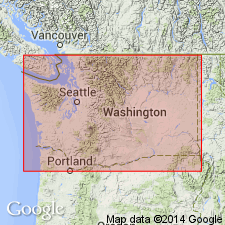
[Type locality and origin of name not stated.] Exposed in northern Cascades, northwestern WA.
Source: US geologic names lexicon (USGS Bull. 1350, p. 18-19); supplemental information (in brackets) from GNU records (USGS DDS-6; Menlo GNULEX).
For more information, please contact Nancy Stamm, Geologic Names Committee Secretary.
Asterisk (*) indicates published by U.S. Geological Survey authors.
"No current usage" (†) implies that a name has been abandoned or has fallen into disuse. Former usage and, if known, replacement name given in parentheses ( ).
Slash (/) indicates name conflicts with nomenclatural guidelines (CSN, 1933; ACSN, 1961, 1970; NACSN, 1983, 2005, 2021). May be explained within brackets ([ ]).